

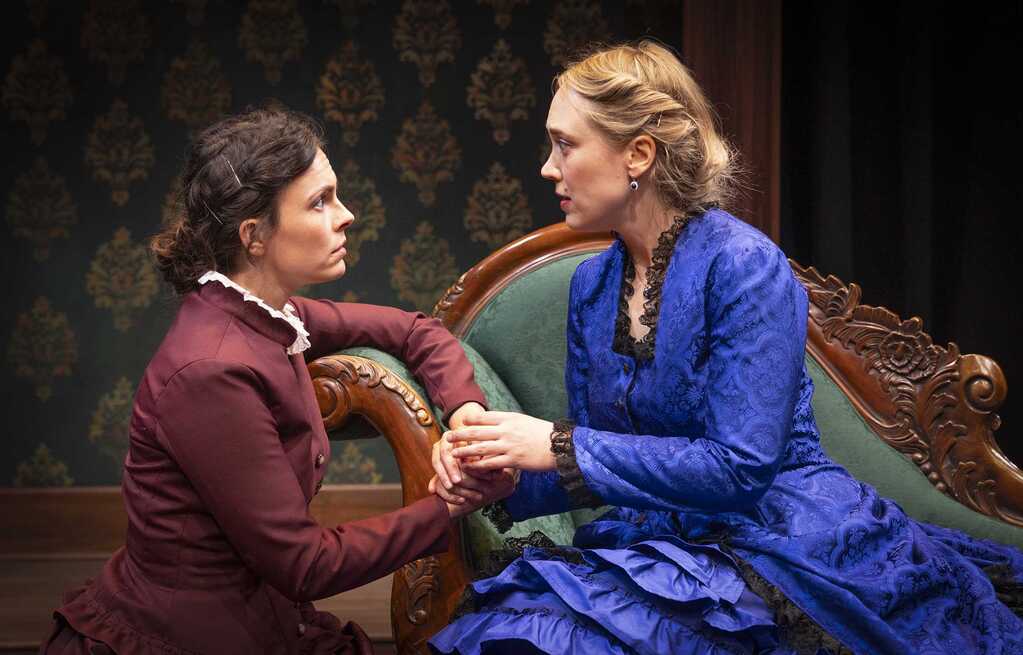
Starting Sept. 4, The Rogue Theatre presents its production of Henrik Ibsen’s classic drama “A Doll’s House.” The play will run through Sept. 27, with performances each Friday and Saturday at 7:30 p.m. as well as Saturday and Sunday at 2 p.m.
The production is directed by Cynthia Meier and stars Sophie Gibson-Rush as Nora Helmer and Aaron Shand as Torvald Helmer. Tickets are $49.
“A Doll’s House” is an 1879 drama written by groundbreaking Norwegian playwright Ibsen. It tells the story of Helmer, a stay at home wife and her marriage with her husband Torvald. While Nora and Torvald appear to live an ideal marriage, the facade splinters and cracks under the crushing gender roles of Victorian society.
“You think, ‘what can a play that is 150 years old tell us?’ And this play has aged remarkably well, and we’re still dealing with the same gender issues that we were 150 years ago. We’re still, I think, reeling from the Victorian era,” Meier said.
Founded by Meier and Joe McGrath in 2005, The Rogue Theatre has remained a staple of the Tucson Drama scene for 21 continuous years. While Meier estimates most theater companies last maybe 5 years, the theater stays in operation thanks to the support of 1,300 season ticket holders.
“That’s really wonderful, because it feels like a family. A big, huge extended family. We’re not performing for strangers every night, we’re performing for people who’ve watched us grow and develop over the years,” Meier said.
Meier has long been interested in adapting “A Doll’s House,” having discovered the play while she was in college. But according to Gibson-Rush, The Rogue Theatre struggled to get the rights, as the play “A Doll’s House” remains widely popular and in demand even 147 years later. The Rogue Theatre is using an adaptation of the play written by Amy Herzog. The Script uses contemporary language, though loses none of the complexity. Gibson-Rush noted that the first 22 pages were particularly hard to memorize.
Having never seen a prior staged production of “A Doll’s House,” Meier and her cast and crew were free to craft a vision from the ground up, unique to The Rogue Theatre.
The Rogue Theatre held a pre-show talk on Friday, Aug. 28, featuring University of Arizona professor Patrick Baliani reading his essay “Henrik Ibsen: Father of Modern Drama.” The essay covered Ibsen’s life, history and controversy, with specific focus given to the social outrage surrounding the initial productions of “A Doll’s House.” Or as Baliani prefers it to be translated, “A Doll House.”
While Ibsen insisted that he did not intentionally write a play addressing “the Woman Problem,” as the Victorians liked to refer to it. Instead, Ibsen claimed he wrote a broadly human one. However, the themes struck a chord with the women’s rights movement. Gibson was even honored by the Norwegian Women’s Rights League. For as much praise as it received, it was equally controversial, as an outraged Victorian audience objected to the play’s challenges to the archetype family and traditional gender roles.
Central to understanding the themes of the play is the main role, Nora, who is described as “rival[ing] Antigone, Carmen, Medea, and Juliet as the most performed, discussed, and debated female character on the international stage.” Stated in the book “A Global Doll’s House”
Taking on the complex and challenging role of bringing Nora to life on The Rogue Theatre’s stage is Gibson-Rush.
Gibson-Rush has been acting since middle school and received a Bachelor in Fine Arts from Boston University. She joined The Rogue Theatre’s ensemble cast 2 years ago and has been featured in plays such as this year’s performance of “The Tempest” in the role of Ariel.
“I’ve had large roles before, but never anything where the success or failure of the play relies on my ability to complete the performance. I think it’s like [the character] Hamlet, ‘A Doll’s House’ is really dependent on the performance of Nora,” Gibson-Rush said.
With the exception of a single scene, Nora is on stage for the entire 135 minute run time. Gibson-Rush finds endurance through precise breathing technique and through the support of her co-stars. She describes each time a fellow actor comes on stage as being like a “draft of wind” which lifts her up again.
The Rogue Theatre has a built-in ensemble of actors who feature in most of their performances. While the theater does enlist talent from open auditions, upon finding they kept casting the same actors over and over, Meier and McGrath developed their core ensemble, who perform in at least three roles a season.
The ensemble allows the cast to develop personal relationships, which Gibson-Rush states that it made it easier to navigate the complex marriage of Nora and Torvald with Shand, who plays the character.
“[It was] much easier than if it was two actors who had never met before for me and Aaron [Shand] to really find safety and curiosity in this marriage. Because we start the play in such a joyful hopeful place and end in this really brutal sundering of the marriage,” Gibson Rush said.
A goal of The Rogue Theatre’s version of the performance, noted by Gibson-Rush and Meier, was to avoid portraying Torvald as a villain. Instead Meier hopes the audience also sees Torvald as a reflection of the patriarchal society he lives in, also performing his masculinity as he believes he is expected to.
“We have all these roles we play as both women and as men. But ultimately we’re all human beings who are just trying to make it through the world the best we can. And trying to understand ourselves on a basic human level. And that really excited me about the play and drew me to the play” Meier said.
If you’re interested in seeing the show, The Rogue Theatre is conveniently located near campus at 300 E. University Blvd. suite 150. For those worried about parking, The Rogue Theatre has laid out available locations on their website.
Follow the Daily Wildcat on Instagram and Twitter/X