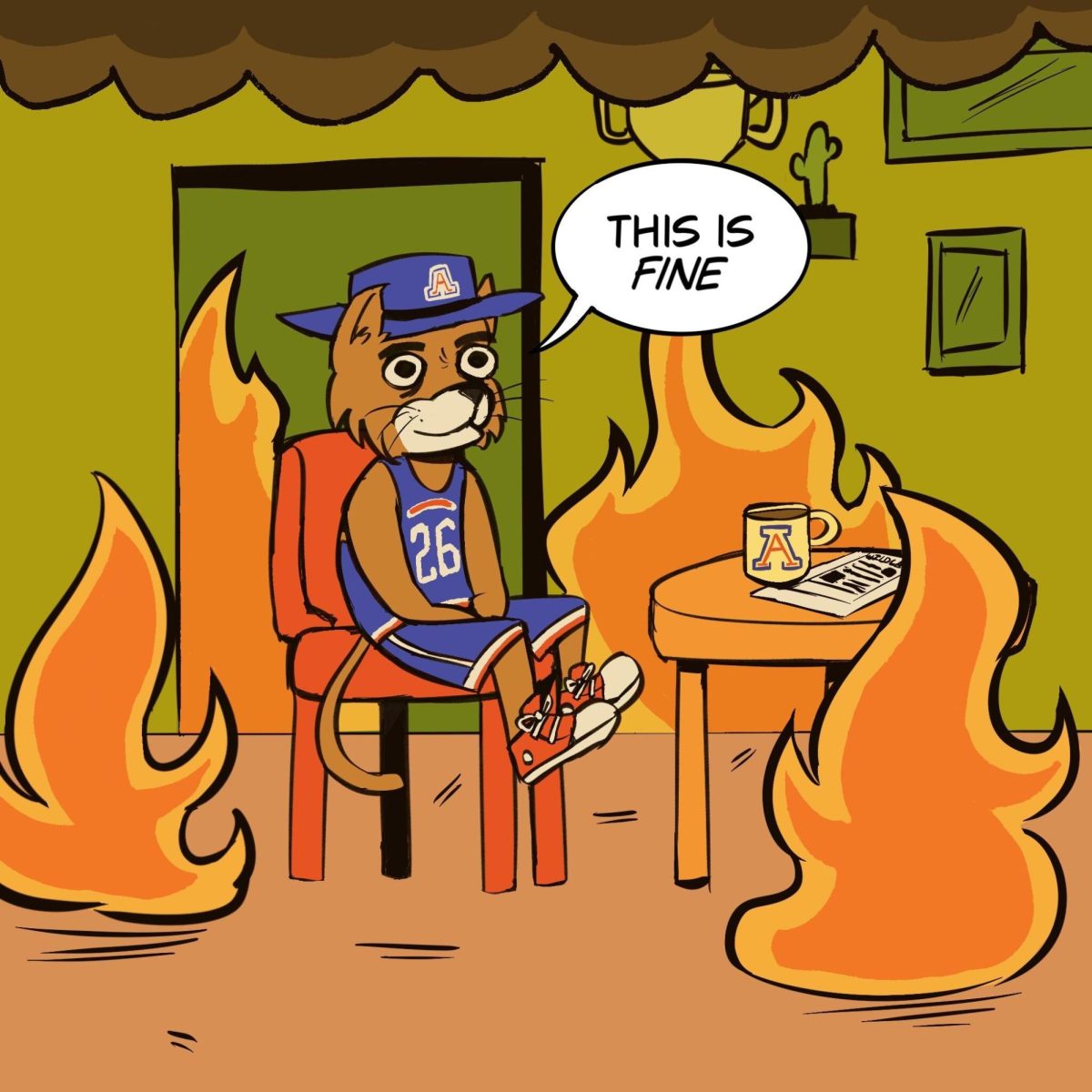


The University of Arizona officially announced its plan to consolidate the seven University of Arizona Cultural & Resource Centers into a singular multicultural hub, Campus Community Connections.
On May 27, this move would shape student spaces that, for decades, have been cornerstones of student life at UA.
Each center was created to serve a specific community and build belonging on campus. Beyond their role as cultural homes, the CRCs offer services that benefit the entire student body: peer mentorship, identity-conscious counseling and campus-wide events that foster cross-community understanding. Despite their long-standing role, the CRCs have now found themselves caught in a broader political battle.
The decision to form the CCC came in the wake of federal orders from the Trump administration to end Diversity, Equity and Inclusion initiatives in American universities. At the University of Arizona, President Suresh Garimella announced the consolidation after Senate President Warren Petersen sent letters to NAU, ASU and UA directing them to end all university-sponsored DEI programs or risk losing federal funding. In response to Petersen’s demands, Garimella returned a letter detailing how the University of Arizona would comply with the new directive.
And while these changes were inevitable under shifting federal policies, the true injury lies in how the shift was handled. The decision was made without prior communication with the very students it affects. CRC directors were dismissed by administration while school was out of session in summer, leaving students with no chance to meet, restructure or respond.
If administrators had genuinely prioritized students’ interests and the preservation of community, they would not have chosen to implement such a massive change at a moment when student communities were most fragmented.
Unfortunately, this story is not new for marginalized students. The CRC consolidation reflects a longstanding divide between students and administration, particularly around CRCs. Just last year, before the current Trump administration, the university attempted to restructure the fourth floor of the Student Union Memorial Center, displacing Survivor Advocacy, the United Fraternity and Sorority Council, UA Cultural & Inclusive Experiential Learning Opportunities and part of Asian Pacific American Student Affairs to make room for enrollment offices. Student centers learned of the plan less than three weeks before their deadline to vacate. In response, more than 200 students packed an emergency town hall with Interim Provost Ron Marx and CFO John Arnold to demand transparency and a halt to the displacement. At the meeting, Marx admitted administrators had not considered the “functional impact” of displacing centers, while Arnold stated that in the future, student feedback would be built into any space moves. Marx even pledged that the administration would “move forward with [students] as collaborators.”
But those words did not translate into action. This past May, students again learned of sweeping changes to their centers not from administrators, but from a press leak revealing the consolidation and the dismissal of all seven CRC directors.
As the consolidation is implemented, centers are having increasing difficulty reaching incoming students. Historically, hundreds of new students attended their identity-based Destination Arizona mixers. This year, the mixers had an attendance of less than 100 new students combined. This can be attributed, in large part, to the unclear placeholder names assigned to centers. New titles like SUMC 404 are simply less appealing and less targeted than LGBTQ student affairs.
New students — those without a safety net and established community — are the most vulnerable to falling through the cracks. These centers have given new students a space to gather their bearings and find a community as they adjust to college. Many cultural centers are affectionately known by their members as , homes away from home. But without proper outreach, students never find out that these communities are even there for them. The impact is a cohort of disconnected incoming students, lost and invisible in a sea of people.
- Bhavya Makkar, APASC Co-Director of External Outreach
When centers are left weakened and without a guarantee of permanent faculty, the responsibility falls to students to organize together.
One of the groups to emerge in response has been the Asian Pacific American Student Council. APASC is a student-led body connected to the APASA center, created to protect and uplift the voices of APASA students. In January, APASC issued a public statement following President Donald Trump’s executive order ending DEI/DEIA programs and Petersen’s letter directing state universities to comply. In that statement, APASC warned that APASA — as one of the seven CRCs — was at risk of losing its student jobs, sponsored programming and even its physical space. Later on, in their July statement on the CRC consolidation, APASC positioned itself as an advocate not only for APASA students, but as part of a broader movement defending the CRCs. They called for students from other CRCs to join the movement to communicate student needs with administration by creating their own representative student councils. APASC demonstrates that student leadership and community-driven advocacy can counteract administrative overreach.
In my conversation with student leaders in APASC, they explained that the consolidation emerged not as a bureaucratic reshuffling but as a rupture in the community.
For Carol Chen, a third-year neuroscience and cognitive science major and APASC co-president, what stood out most was the scale of the decision. “All the centers were affected at the same time, without any prior notice to students. The directors of each CRC were fired from their jobs and that was shocking to a lot of us,” Chen said. “I don’t know if anything this large-scale, with so many ramifications for cultural centers, has happened before.”
Peter Wolverton, a sophomore studying data science and APASC’s director of internal outreach, described what that loss means on the ground. “We all kind of come in fumbling and not really knowing what we’re doing. These spaces give stability. To take away that continuity, that sense of belonging — it’s not going to go well,” Wolverton said.
He also pushed back on the idea that CRCs can simply be replaced by other avenues for connection: “There are clearly thousands of students who connect with these centers. Removing them because you don’t think they’re the right way to build community makes no sense.” Wolverton noted that the right for other avenues of student connection to exist, like Greek Life, has never been challenged to this degree. Other APASC council members recounted similar stories of feeling lost and lacking security before finding APASA.
For John Piamonte, a fourth-year neuroscience and psychology major and APASC co-president, the problem was not the decision itself, but the way it was made. “A lot of these administrators have actually never stepped foot in the CRCs, much less met the students they serve,” Piamonte said. “If administration hasn’t been transparent with us in the past, then we need to make our needs known ourselves instead of waiting for them to listen.”
“We’ve been told we can’t even have the word ‘Asian’ in our name. It feels like these changes are targeting me and others in the community by stripping us of a word that so many identify with,” Auhona Shil, a physiology and medical sciences sophomore and APASC’s co-director of external outreach, said.
Wolverton added that this disregard was not new, recalling how in the fourth floor dispute, Arnold admitted he did not know what was happening on the fourth floor of the student union. “If they cared a little bit more, it might earn them more grace,” Wolverton said.
Amid the frustration, these students also described why they continue to organize even when the odds feel stacked against them. Shil acknowledged the emotional toll, admitting that she sometimes feels powerless in the face of sweeping administrative decisions. But she also emphasized that the council itself transforms that powerlessness into action. “Being part of APASC gives me power,” Shil said. “Just having a platform for us to meet and act gives me hope.”
Chen echoed this mix of fear and resilience. “It’s emotionally taxing. It feels like we’re not being listened to, but knowing that others will step up [with me] keeps me going,” Chen said. For Chen, the structure of APASC — its co-leadership model, shared responsibilities and collaborative culture — makes advocacy sustainable. When one student is stretched thin, another steps in. That system, she noted, reflects the very community they are fighting to preserve. One built on support, mutual care and persistence in the face of indifference.
If given the chance to speak directly to administration, the student leaders in APASC mentioned their biggest request would simply be for attendance. “I’d ask them to come down to the resource centers and actually see what’s happening,” Wolverton said. “We often invite them, but rarely see anyone show up.” Across this conversation, the sentiment was clear: if the administration would sit with students, feel their community and experience their culture firsthand, they would better understand what is at stake before dismantling CRCs and other community spaces.
- Andres Diaz, Opinions Writer
APASC isn’t alone in feeling that they’re not being heard and are powerless to administrative actions. Combined, the seven CRCs serve around 28,000 students. But only about 3,300 people — including faculty — signed the DEIA petition delivered to Garimella. That’s a participation rate of less than 12%. This is a concerning diagnosis of widespread student lack of involvement in the decisions that affect them. On the surface level, it looks like apathy. But in reality, it’s a result of a shared feeling of learned helplessness and a lack of precedent and centralized mode of community action.
But, as the multiple thousands of students that did sign the petition know, marginalized students cannot afford to stay silent as our culture is erased. The consolidation of the CRCs necessitates a unified response from students.
Unification is a daunting goal, but it is not impossible. For evidence of that, we can look to the history of marginalized students’ activism on our own campus. Less than a decade ago, in 2016, the then six CRCs released a joint statement detailing the Marginalized Students of the University of Arizona’s list of demands.
This is a time to organize together. Instance after instance of administrative decisions made without student input have made it abundantly clear: students cannot rely on administration to bring avenues of communication to our spaces — we must bring ourselves to them. Marginalized students must decide together — what is it that we want administration to know, and how can we develop a centralized message to share with them? APASC argues that the most effective way to reach administrators with student voices is through a coalition of CRC student councils. Perhaps achieving this goal will finally bring students the communication they deserve.
There’s an idea in biology that I really hold on to. It’s called emergent properties, and it refers to the characteristics that arise from the interaction of components that don’t exist in the component itself. Organs have more functionality than cells, organisms more than organs and ecosystems more than organisms.
Think of a bicycle.
A pile of metal spokes can’t do anything, but when organized into a circle, they become a wheel; more useful, but still not transportation. Add another wheel and more metal parts, and now you have a functional and incredibly useful vehicle.
All that to say: your power is a small part of big progress. Our way forward is coming together. Organized, we are a vehicle. Organized, we can create a movement. And nothing, no erasure, no administration, no country, can quiet it.
- Bhavya Makkar, APASC Co-Director of External Outreach