
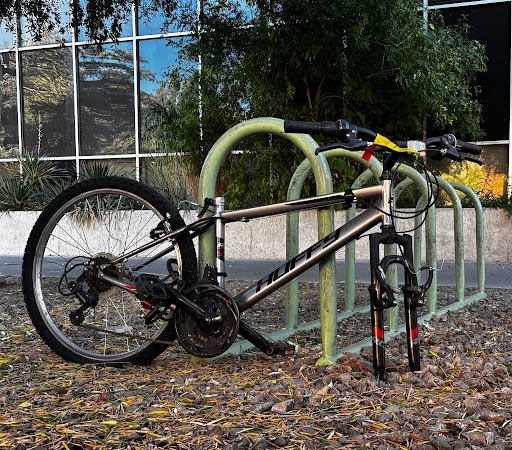
On Feb. 18, 2025, Salena Torres Ashton, a University of Arizona Ph.D. student studying information science, returned to find that her bicycle she had secured with two cable locks had been stolen.
“I filed a report, and I was uncharacteristically mad — pissed off,” Ashton said. “I called them [University of Arizona Police Department] a few days later because they gave a lot of attention to my case and they didn’t take my anger personally.”
Despite her disappointment with the slim chance of getting her bicycle back, she was grateful for UAPD’s effort. As a display of gratitude, she offered to help them anyway she could with her data science background. Ashton explained that soon enough, she was in contact with records management, crime analysts and detectives.
In 2024, the UA Office of Public Safety estimated that roughly 10,000 students, faculty and UA employees regularly commute to campus via bicycle. The campus offers several bicycle-only paths to promote safe commuting and was recognized by the League of American Bicyclists as a gold status bicycle friendly university.
However, bicycle theft still presents a long-standing threat to the UA community. In response, UAPD, OPS, Parking and Transportation Services and more UA departments created a working group in hopes of better addressing it.
“I think we have identified — through talking to parents, talking to student government leaders, faculty and staff, obviously, police reports — that bike theft and the security of bikes on campus is a concern,” UA Deputy Chief Safety Officer Eric Kazmierczak said.
The group’s aim is to analyze bicycle theft trends on campus, look to see what interventions are effective at other campuses and apply that knowledge towards prevention at the UA.
“It’s always been a problem,” Kazmierczak, who had his own bicycle stolen while he was a UA student, said. “We’ve just never addressed it. We now understand that that’s a problem. I think, with the Office of Public Safety and the partnerships that we’ve got, we’ve built a team that is able to research and use evidence-based strategies to try and address this problem, so now’s the time to try and work on it. I would argue that we should have been trying this years ago, but we’re here now, and we’re gonna work on it now.”
Alongside the UA group, Ashton began sifting through bicycle theft data. While she was well versed in mathematics and data science, going through crime data was new to her.
“I fell in love with it,” Ashton said. “I didn’t expect that. I just wanted to tell them thank you, and within two weeks, I thought, ‘Wouldn’t it be great if I did a dissertation on this?’”
After getting approval from her Ph.D. advisor and UAPD, she began turning her analysis work into her dissertation.
According to Ashton’s research of UAPD reports, from January 2024 through November 2025, there were 448 reported bicycle theft-related crimes, which she defined as those that “demonstrate probable cause for bike theft.”
Not adjusted for inflation, the total reported cost for victims across the span of those 23 months came out to $190,975. Ashton noted, however, that roughly one-third of victims did not include cost in their reports. Extrapolated out to account for the unreported costs, that number rose to $238,000.
Across that same time period, 65 electric bicycle and scooter theft-related crimes were reported, with an overall reported cost of $35,867.86. Eight of those reports did not include cost, but the sample size was too small to reliably extrapolate in order to account for those, Ashton explained.
The average reported cost of a stolen non-motorized bicycle was $629.26 — for electric bicycles, it was $752.13.
Both Ashton and Kazmierczak noted that many thefts go unreported. When Kazmierczak’s own bicycle was stolen in the 1990s, he did not report it. Ashton offered a rough estimate, stating that about 30-50% of bicycle thefts likely go unreported.
The research results also showed that the thefts are concentrated on the edges of campus, especially the southwest corner and near the UA Honors Village.
The overall cost of bicycle theft goes beyond just property crime. It negatively impacts the overall community too, UA PTS Alternative Transportation Manager Anona Miller explained.
“I think there’s also so much community that gets built directly around cycling or using other forms of micromobility,” Miller said. “For me with my personal commute to work, I see other people on bikes. I see my friends sometimes, and it’s really easy for us to stop and say hi if we want, or just give a little hand wave as you’re biking. That to me is such a positive aspect of community connection and bonding that I would never have in a car, and I think also here on campus, specifically, not being able to bike, not feeling safe or comfortable biking to campus means that you’re gonna feel the need to drive and find a place to park, which is incredibly expensive here.”
In addition to the added expense and limited parking on campus, more cars on campus presents a greater risk for those who do not commute by car.
“Having an increase in vehicle traffic around campus creates a less safe environment for pedestrians and cyclists,” Miller said. “If you have a lot of people that are coming down Fourth Street, for example, […] there’s a big pedestrian/cyclist crossing there, so the more vehicle traffic you have, the less safe it is for those other users of the roadways.”
As part of the working group’s research, they looked at what interventions and preventive measures have been most effective. One of the most noteworthy deterrents stems from community bystandership, Kazmierczak explained. If there are more people in the area looking out for one another, there will be fewer opportunities to steal bicycles.
“The best evidence of that are the bike valets,” Kazmierczak said. “We have two Bike Valets on campus — one north of Speedway and one right there in front of Nugent [building] on the main mall. We know that those work really, really well at reducing bike theft. You park your bike in the bike valet, and it’s not gonna get stolen, because there’s somebody sitting there watching the bike. It’s enclosed — not with a fancy enclosure, right? It’s not Fort Knox. It’s just a low fence, but you have people who are actively participating in the safety of your bike while it’s there.”
According to Kazmierczak, because of the high concentration of thefts near the Honors Village, they are working on a pilot project to try out cost-effective preventive measures in that area.
In an effort to work within the environmental constraints and avoid a high priced enclosure, the working group is looking at simpler interventions. In addition to improving security cameras in the area, they are planning on moving bicycle racks closer to building entrances and other higher traffic areas to deter possible thefts.
Another step under consideration is adding more physical deterrents and barriers such as decorative boulders and an automated voice message system that is triggered when someone enters the bicycle rack area.
On an individual level, there are a few important steps which members of the UA and greater Tucson community can take to lower the risk of their bicycle being stolen, according to Ashton. The lock type matters less than most people think, she explained.
“U-locks are no more effective than cable locks because they’re easy to pop,” Ashton said. “When people say, ‘Use a U-lock, use a U-lock, use a U lock,’ it sounds like a very easy thing to do, but when I talk to the patrol officers, they’re telling me that they’re picking up U-lock parts all the time.”
She noted, however, that using two locks — one on the frame and one on the front wheel — is an effective strategy for deterring thieves. Where someone parks is also an important aspect. Finding a well traveled, well lit area is more important than the type of lock itself. Making use of the available bike valets also better ensures that it will still be there when they return, she added.
To use the bike valet, riders must register their bicycle with Project 529, which is free through the UA. The software serves a database of bikes, storing the bike’s make, model and serial number with its owner’s information.
Through registration with Project 529, people can prove ownership of their bicycle, which geotagging alone does not do, Ashton explained. In the rare chance of a bicycle being recovered, one needs to prove ownership to have their bike returned.
Information about bike valets, registration and other available parking can be found here.