
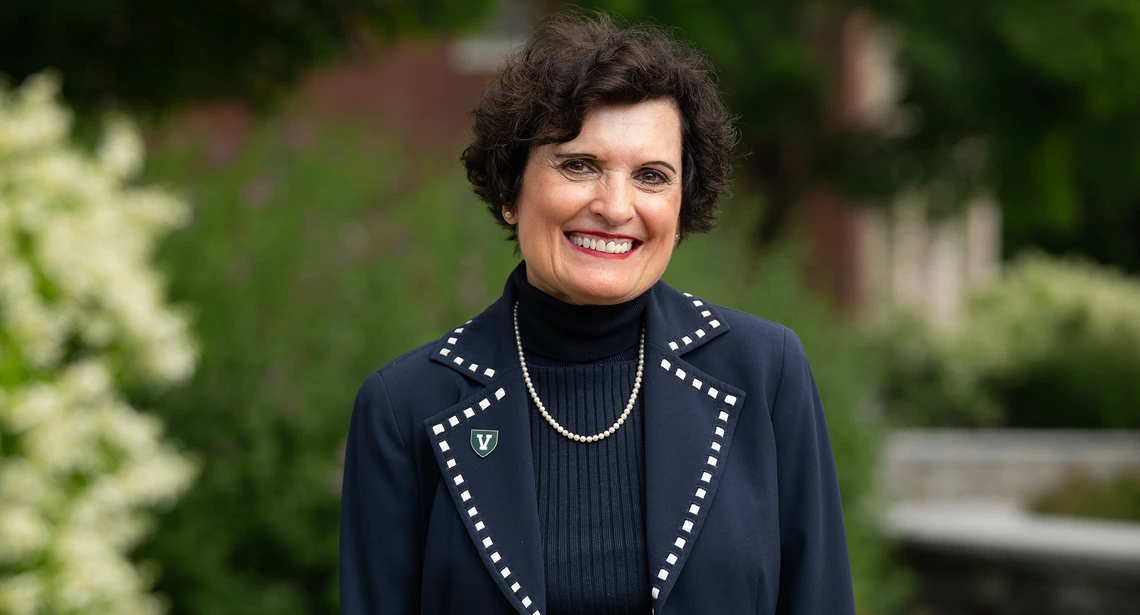
University of Arizona President Suresh Garimella announced Tuesday that starting on Monday, May 19, Patricia Prelock will become the university’s next senior vice president for academic affairs and provost.Prelock has served as interim president at the University of Vermont since October, where she has also been provost since 2019.
Prelock is one of four candidates that a UA search committee selected to replace Ronald Marx, the current provost and interim senior vice president for academic affairs.
Marx served as interim provost during the 2023-2024 academic year and was reappointed the following year after the resignation of Joe Glover. To introduce the provost candidates, the UA hosted open forums held in-person and remotely over Zoom for faculty and staff.
Prelock spoke at her open forum in the Center for Creative Photography on Thursday, March 13. Prelock has worked for the University of Vermont for the past 30 years in several positions.
“I see myself as an institution builder and not a career builder. I go where institutions need me so that I can support their development,” Prelock said.
One way to support development, according to Prelock, was supporting faculty.
“Our students will tell you, they really want a good teacher, so that they can really understand the content, ask questions, and get inspired by what you bring, so I really appreciate our master teachers and that’s always been a huge component of support,” Prelock said.
When asked about protecting DEIA-related practices and resources to support students and faculty, Prelock said, “If you look at the strategic imperatives that President [Suresh] Garimella has set up, the expectations should be success, academic success, access and affordability for all students. That’s the answer for all students.”
Prelock talked about the importance of leaning into core university values.
“I think we just really have to lean into your values — inclusion, determination, adaption, aspiration — all of those things,” Prelock said.
One of the reasons Prelock said she chose to pursue the UA provost position after a long career at the University of Vermont was because of leadership under Garimella, who became the University of Vermont president in 2019.
“Dr. Prelock is a highly accomplished scientist and scholar, clinical speech-language pathologist, and university leader”, Dr. Garimella wrote in an email statement Tuesday. “As a university leader, Dr. Prelock is known for her focus on the well-being and success of students, faculty, and staff, and she is the ideal person to lead our academic enterprise into the future.”
Amanda Kraus and Chrissy Lieberman, who were both acting in interim roles, also now hold permanent positions.
Kraus is the official vice president for student affairs and Lieberman is the official dean of students.
Kraus, the new VP for student affairs, moved to Tucson for graduate school and earned her master’s and doctorate from the College of Education. She has taught higher education courses at the university for nearly 15 years and was previously the executive director of the Disability Resource Center.
After more than two decades working in student affairs, Kraus now leads UA’s six student affairs departments: Campus Health, UA Counseling & Psychological Services, Campus Recreation, the Dean of Students Office, the Disability Resource Center, Housing and Residential Life and Student Engagement and Career Development.
SECD is a new addition to student affairs that was created to connect current and alumni students to career and networking opportunities.
Kraus also explained that student affairs recently had a change in their adaptive athletics program. The program moved from the Disability Resource Center to Campus Recreation. Kraus mentioned the shift was intended to integrate adaptive sports more fully into the university’s broader athletic offerings.
“Campus Recreation supports all club sports […] so we thought that is where adaptive athletics and wheelchair sports belong too, not separate in a service office. It is not a special program, these are competitive sports,” Kraus said. “We want to be demonstrating to all of campus that all students belong in the Rec.”
In regard to the current federal landscape surrounding DEI and international students, Kraus explained the university is still evaluating how to respond to uncertainty around policy, but she understood the confusion and concern that students are facing.
“I want to validate that those emotions are real and understandable, and we are working really hard on how to respond,” Kraus said. “In terms of clarity, I wish I could say something definitive, but I can’t. What I can say is that we are taking this very seriously. We are trying to do the best for the community, for the students, while maintaining necessary compliance.”
Kraus ended with hopes to create more ways for students to give feedback, suggesting town halls and advisory groups.
“I really want to hear from students because I think it is very important for them to be able to voice their opinions, give feedback and know the person they’re delivering the feedback to. I would like to make myself available to students,” Kraus said.